When Mining Companies Leave, African Communities Pay
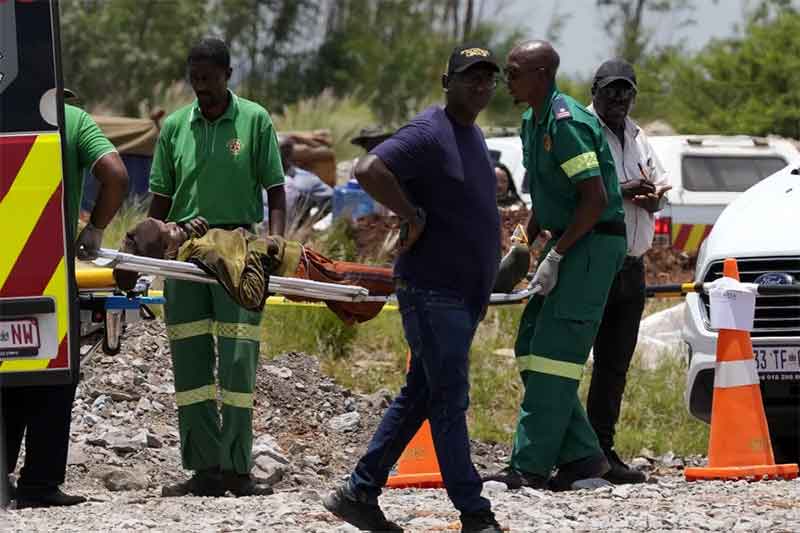
A miner is transported on a stretcher by rescue workers after he was rescued from below ground in an abandoned gold mine in Stilfontein, South Africa.
Themba Hadebe/AP
As policymakers and executives gathered this week at the African Mining Indaba in Cape Town, the narrative was familiar: Africa as a cornerstone of the global energy transition, rich in critical minerals and open for investment.
Yet beneath the celebratory announcements and investment pledges lies a rarely discussed question: what happens when mining companies leave?

The Overlooked Phase: Corporate Exit
In the global race for critical minerals — from platinum and lithium to copper and cobalt — the spotlight remains fixed on new exploration projects and capital inflows. But in many African jurisdictions, the most consequential phase of mining is not entry, but exit.
When multinational mining companies divest assets, restructure operations or relocate headquarters, social, environmental and fiscal liabilities often remain behind. While capital is mobile, accountability is largely national — and frequently weak.
South Africa’s Case Study
South Africa provides a stark illustration. Mining has shaped its economy, labour systems and settlement patterns for more than a century. One of the country’s most influential firms, Anglo American, has in recent years streamlined its global portfolio, significantly reducing its domestic footprint.
Between 2021 and 2024, Anglo American’s South African workforce declined by over 20%, while its tax and royalty contributions fell sharply. While such shifts may reflect commodity cycles and corporate restructuring strategies, they also expose a structural imbalance: corporations can relocate capital swiftly, but affected communities cannot.
Abandoned Mines, Enduring Costs
The environmental and social consequences of exit are visible in provinces such as Mpumalanga, where decades of coal and gold mining have left hundreds of abandoned or inadequately rehabilitated sites. Acid mine drainage continues to contaminate water systems, while formal mine-closure certification remains slow and limited.
For mining towns, the impact is immediate and severe. Municipal revenues shrink, infrastructure deteriorates and employment-linked housing becomes precarious. In towns such as Kriel, residents have faced eviction following changes in mine ownership, highlighting how corporate transitions can trigger housing insecurity and social disruption.
The Regulatory Debate
Critics argue that stricter regulations risk deterring foreign investment — a serious concern for governments grappling with unemployment and debt pressures. Yet the issue may be less about regulatory burden and more about enforcement and global governance gaps.
While multinational corporations can shift profits, assets and legal domiciles across borders, environmental and human-rights enforcement mechanisms remain largely confined within national jurisdictions. This asymmetry gives companies leverage: the credible threat of exit.
Countries such as Canada maintain stricter mine-closure requirements and conduct public-interest reviews of major restructurings, yet continue to attract mining capital. The contrast suggests that predictability and governance strength may matter more than regulatory leniency.
The Clean Energy Paradox
As demand for critical minerals accelerates under decarbonisation agendas, Africa’s resource endowment is increasingly framed as an opportunity for growth. But without robust accountability frameworks, the energy transition risks replicating the extractive patterns of the fossil-fuel era — concentrating profits while externalising long-term costs.
National reforms are necessary, but not sufficient. Advocates increasingly point to the need for stronger international mechanisms, including binding frameworks on business and human rights, to address transnational power imbalances.
Beyond New Beginnings
The African Mining Indaba positions itself as a forum shaping Africa’s mining future. Yet meaningful transformation will require confronting what happens after projects wind down.
Because in mining, endings reveal the true distribution of risk.
When companies exit, costs do not vanish. They are transferred — to municipalities struggling with eroded tax bases, to ecosystems left contaminated, and to communities with limited mobility.
As Africa positions itself at the centre of the global critical minerals supply chain, the question is no longer simply how to attract investment — but how to ensure that when extraction ends, communities are not left to pay the price.
Share this content: