Artificial Intelligence Set To Transform Africa’s Mining Industry And Cut Global Costs
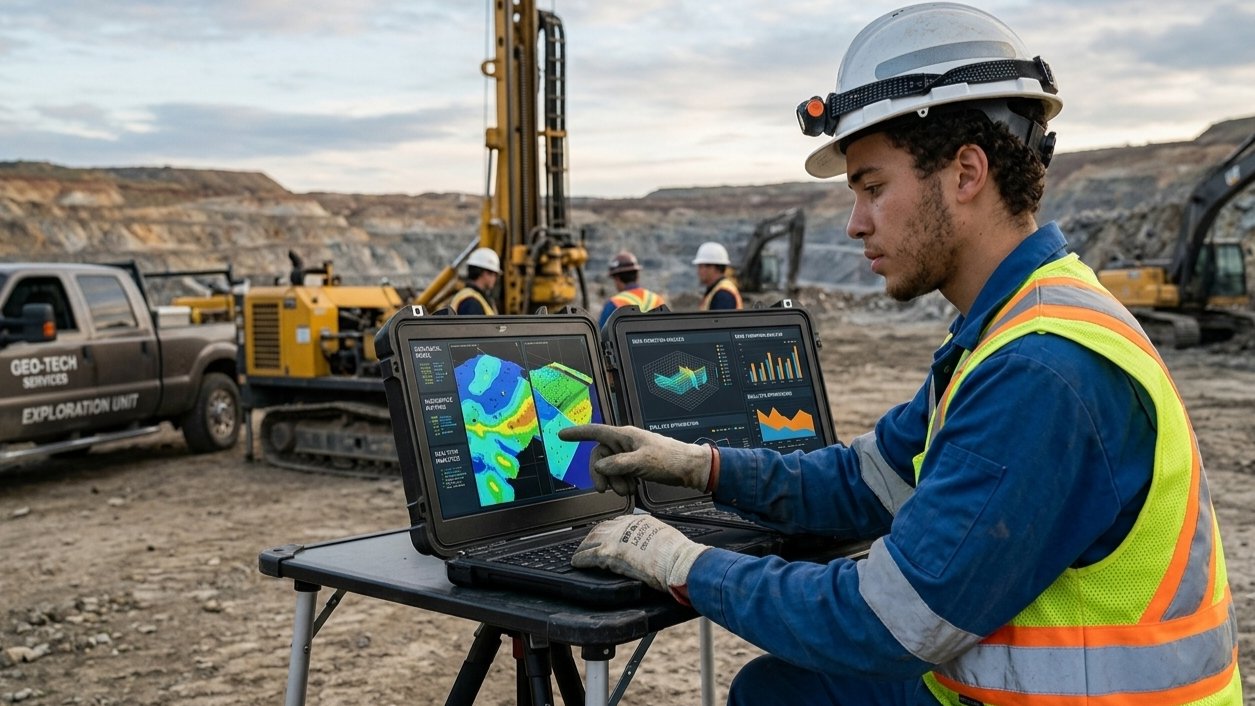
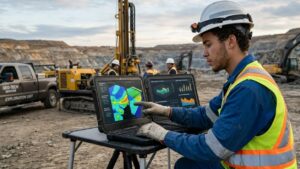
A field operator monitors AI-driven geophysical data on a mobile tablet during subterranean mapping, illustrating advanced exploration techniques deployed in Southern Africa | Google
Artificial intelligence (AI) is rapidly becoming one of the mining industry’s most transformative technologies, with new research suggesting it could generate between US$290 billion and US$390 billion in annual operational savings globally by 2035.
A report by the Atlantic Council highlights how AI-powered exploration, predictive analytics and digital technologies are helping mining companies reduce costs, accelerate mineral discoveries and improve production efficiency. For Africa, home to some of the world’s richest mineral reserves, the technology presents an opportunity to strengthen its position in the global critical minerals market.

AI Revolutionising Mineral Exploration
Traditional mineral exploration has long relied on costly geological surveys, drilling programmes and years of fieldwork. Artificial intelligence is changing that process by analysing enormous volumes of geological information within hours instead of months.
Machine learning models can process satellite imagery, historical drilling records, geochemical data and geophysical surveys to identify the most promising mineral targets with remarkable accuracy.
Industry estimates suggest AI-assisted exploration could reduce exploration drilling requirements by as much as 75%, allowing companies to discover new deposits faster while significantly lowering exploration costs.
Africa Holds A Strategic Advantage
Africa possesses approximately 30% of the world’s critical mineral reserves, including copper, cobalt, lithium, manganese, platinum group metals and rare earth elements that are essential for electric vehicles, renewable energy systems and advanced electronics.
Despite this abundance, the continent currently attracts only a small share of global exploration investment. In many countries, geological information still relies on outdated surveys conducted decades ago, limiting investment opportunities.
AI offers a practical solution by modernising geological databases, improving resource mapping and providing investors with greater confidence when evaluating new mining projects.
Southern Africa Leading Adoption
Several African mining jurisdictions have already begun integrating artificial intelligence into exploration and production activities.
In Zambia, AI-driven geophysical mapping and predictive modelling are helping refine exploration targets at major copper operations, supporting efforts to expand production.
Mining companies in South Africa, Botswana and the Democratic Republic of Congo are also adopting drone technology, automated monitoring systems and advanced data analytics to improve mineral recovery, optimise processing operations and increase operational efficiency.
These technologies allow mines to extract more value from existing operations while reducing waste and lowering operating costs.
Supporting Sustainable Mining
Artificial intelligence is also helping mining companies improve environmental performance.
Digital monitoring systems optimise water usage, reduce energy consumption and enable more precise extraction techniques that minimise unnecessary disturbance to surrounding land.
Predictive maintenance systems further improve sustainability by reducing equipment failures, lowering fuel consumption and extending the operational lifespan of expensive mining machinery.
These improvements support the mining industry’s growing focus on environmental, social and governance (ESG) standards.
Calls For Greater Investment
While AI adoption is accelerating, experts believe investment remains uneven across Africa.
The Atlantic Council has proposed establishing a US$300 million public-private smart mining fund to support technology development, improve digital infrastructure and encourage wider adoption of AI across the continent’s mining sector.
Such investment could help local technology companies develop mining solutions while attracting greater private investment into mineral exploration.
Building More Value from Africa’s Minerals
Beyond improving exploration efficiency, artificial intelligence could help African countries capture more value from their mineral resources.
Better geological information, improved resource management and enhanced operational efficiency would strengthen governments’ ability to negotiate mining agreements, attract responsible investors and expand downstream mineral processing industries.
Rather than relying solely on exporting raw minerals, AI-driven mining could support the development of more competitive, technology-enabled mining sectors capable of producing higher-value products for global markets.
As worldwide demand for critical minerals continues to grow, artificial intelligence is expected to become an essential tool in helping Africa unlock its vast mineral wealth while improving efficiency, sustainability and long-term economic returns.
Share this content: