EFFECTIVE DUST CONTROL FOR ECO-FRIENDLY UNLOADING

BLT WORLD’s Samson travelling Eco-Hoppers have been developed with an effective dust control system that minimises the escape of dust during the grab discharge cycle in bulk materials handling.

“Samson Eco-Hoppers are contributing to port efficiency globally, by ensuring a dust-free environment, at the same time optimising the flow and intake speed of raw materials, for seamless operations,” states Ken Mouritzen, managing director, BLT WORLD. “These eco-friendly, compact hoppers Eco-Hoppers are designed to suit the characteristics and flow properties of virtually any bulk material, including coal, iron ore, gypsum, copper concentrates, soda ash and wood chips.

“The Samson Eco Hopper is designed to receive bulk materials from vessel-mounted or shore based grabs and employs a variety of dust control measures before discharging the material into trucks, rail cars or onto a transfer belt conveyor. Mounted on rails or wheels, the Eco Hopper can be positioned along the quay as required. The throughput of the terminal can be increased by adding one or more hoppers and ensuring that onward handling systems can accommodate the increased capacity.

“These robust grab unloading hoppers, which are manufactured to withstand tough conditions in bulk handling, offer handling rates to 5 000 tonnes per hour, depending on grab crane performance. This low-maintenance system also reduces capital equipment investment and minimised operating costs.”

Samson Eco-Hoppers have an upper and lower section, separated by a dust retention feature, the ‘Flex-Flap’. This divider, which comprises a series of pressed-steel sections and vertical rubber flaps, opens to allow the free flow of material into the hopper and closes to prevent the flow of air out of the hopper.

When bulk material is released by the grab, it falls through the Flex-Flap and accumulates in the inner hopper below. The hopper system automatically closes as a result of the newly created pressure differential between the hopper and the atmosphere, forming a seal to contain the dust contaminated air. Integral reverse jet filters are positioned around the hopper inlet to extract and clean the dust laden air. Collected dust is then re-cycled into the mainstream of material. 

The Flex-Flap feature reduces the volume of exhausted air necessary to control fugitive dust and requires the use of small, compact filters rather than a large de-dusting system.

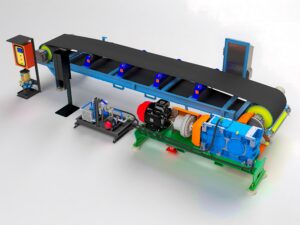
Discharge of materials from the Eco-Hopper may be direct to a belt conveyor for a fixed installation. In this case, the bulk material is reclaimed by a gravity discharge unit which feeds the material onto the conveyor at the required output rate. By using a dust-controlled loading spout, the hopper can discharge direct to tipping trucks.

For handling difficult materials, one or multiple Samson feeder units can be integrated with the Eco-hopper, to provide controlled rate feeding of virtually any material.

Eco-Hoppers can be rail mounted or bolted to suitable concrete foundations. For applications requiring a higher level of manoeuvrability, hoppers can be supported on solid rubber filled pneumatic tyres. The combination of fixed and steering axles provides the option of power travel.

Four Samson Eco Hoppers, which were installed at Kenya’s Port of Mombasa a few years ago, have significantly improved port facilities, also minimising the environmental impact of bulk handling operations at the harbour.

These fully-mobile Samson hoppers, with powered travel and crabbing functionality for easy positioning alongside the vessel during unloading, can be manoeuvred off the quay, freeing up space when they are not in use.

BLT WORLD is the exclusive distributor in Africa for the Samson range of bulk handling equipment, which includes material and boom feeders for loading and high-capacity stockpiling, mobile shiploaders and Eco-Hoppers.

Share this content:

Michael van Wyk — Head Writer, MiningFocus Africa Michael van Wyk is the Head Writer for MiningFocus Africa, specializing in Africa’s mining and resources sector. With over a decade of experience, he reports on gold, copper, critical minerals, and mining digitisation, translating complex industry trends into clear, actionable insights. Michael has interviewed top executives, policymakers, and technical experts, making him a trusted voice on the continent’s mining markets and investment landscape.

Previous post

South Africa-headquartered PGMs and gold mining major Sibanye-Stillwater has announced the financial close and start of construction of two additional renewable energy projects for its SA operations. Aside from South Africa, the company is an emerging lithium producer through the Keliber project in Finland plus in the US produces PGMs at the Stillwater and East Boulder mines; and in Australia produces zinc from the New Century tailings retreatment operation. The first renewable project, the Witberg wind energy project, located near Matjiesfontein in the Western Cape province with a contracted capacity of 103 MW, will generate renewable energy and supply the SA operations via a wheeling agreement with Eskom. The estimated project cost is ZAR3.4 billion, which will be fully funded by Red Rocket, the South African Independent Power Producer (IPP) developing the project, and its lenders, with Sibanye-Stillwater committing to a 15-year Power Purchase Agreement (PPA). This will be the largest private wind farm constructed in South Africa to date, following the 89 MW Castle wind energy project announced by Sibanye-Stillwater on 29 May 2023. Construction of the Witberg Wind Farm will commence in December 2023, with commercial operation scheduled for Q4 2025. The second project is a multi-buyer 150 MWac solar photovoltaic project developed and financed by SOLA Group, a South African IPP. Sibanye-Stillwater will procure 75 MW of the plant’s capacity over a 10-year PPA. The project will be the first to sell power to multiple buyers across the country on flexible terms. The project has an estimated cost of ZAR2.8 billion, with SOLA Group as the majority equity shareholder. The project will generate renewable energy in the Free State and will supply Sibanye-Stillwater’s SA operations via a wheeling agreement with Eskom. Notably, a significant portion of the project’s capacity has been reserved for flexible, short term PPAs, unlocking access to affordable and reliable renewable energy for other South African businesses. Construction of the solar project will commence in December 2023, with commercial operation scheduled for Q3 2025. These projects, together with the Castle wind energy project, bring the total dedicated capacity of renewable energy projects in construction for Sibanye-Stillwater to 267 MW, fulfilling 45% of its long-term renewable energy requirements in South Africa and making Sibanye-Stillwater the market leader in private energy procurement in the country. Combined, these projects will enable a 15% reduction in Sibanye- Stillwater’s Scope 2 emissions, or c. 921,000 t CO2 per year from 2026, and will materially contribute to alleviating the South African electricity crisis. They will further enable socio-economic development for local communities and meet the requirements of the South African Mining Charter. Sibanye-Stillwater continues to pursue the balance of its c.600 MW portfolio of renewable energy projects in its journey to carbon neutrality. Sibanye-Stillwater CEO, Neal Froneman said: “We continue to take meaningful strides toward our target of achieving carbon neutrality by 2040. These renewable energy projects will not only facilitate operational decarbonisation and aid in mitigating climate change but will also contribute significantly to sustaining the shared value creation of our SA operations and assist in addressing the South African electricity crisis. We continue to seek innovative energy solutions for our business and partners that align with our strategy.”

Next post

African countries lost control to foreign mining companies

error: Content is protected !!