JNIM Intensifies Attacks on Illegal Gold Mining Operations in Mali
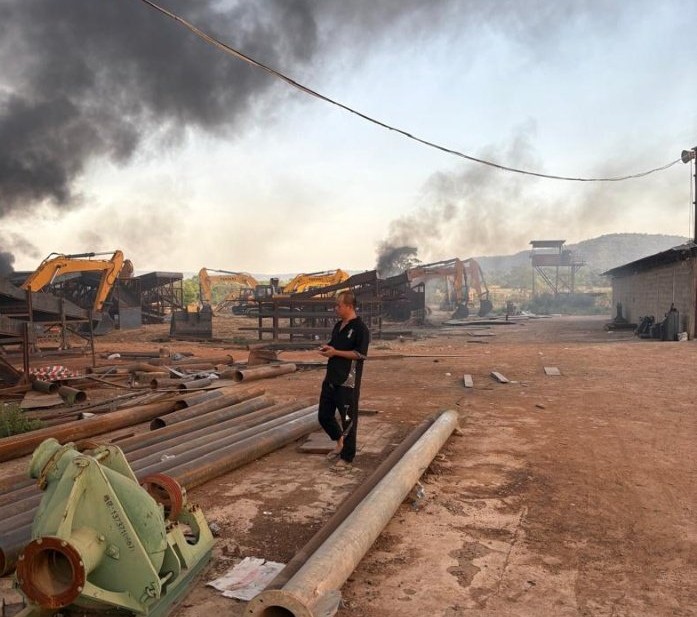
Image: Terrorists attacked a mining site operated by Chinese nationals in Naréna, Mali, on May 12, 2025. MOHAMED LILLY
The growing influence of militant groups in Mali’s gold-producing regions is creating new risks for the country’s mining sector, with Jama’at Nusrat al-Islam wal-Muslimin (JNIM) increasingly targeting illegal mining operations linked to foreign nationals.
Security analysts say the al-Qaeda-affiliated group is using kidnappings, extortion and taxation of informal mining activities to generate revenue and strengthen its operations across the Sahel.

The escalating attacks have placed illegal artisanal gold mining sites, particularly those involving Chinese nationals, under heightened scrutiny from both Malian authorities and international stakeholders.
Gold Mining Becomes a Strategic Target
Mali is one of Africa’s leading gold producers and rising global gold prices have encouraged the expansion of both formal and informal mining activities across the country.
Many of the attacks have occurred in gold-rich regions including Kayes, Koulikoro and Sikasso, where informal mining operations have attracted increasing numbers of foreign investors and workers.
According to security experts, JNIM’s objective is not necessarily to control mining sites directly but rather to profit from the movement of gold, mining activities and transportation routes through taxation and extortion.
The strategy allows the group to generate significant income while maintaining pressure on the Malian government and local economic activity.
Chinese Nationals Face Growing Security Threats
Chinese nationals have become frequent targets of kidnappings and attacks linked to mining operations in Mali.
Following a series of incidents, Chinese authorities issued warnings advising citizens to cease involvement in illegal artisanal mining activities and leave high-risk areas.
Security concerns have been amplified by reports of kidnappings, attacks on mining camps and fatalities involving foreign workers operating in remote mining regions.
Analysts note that Chinese companies have expanded their presence in Mali’s mining sector in recent years as global demand for gold and critical minerals has increased.
Financing Armed Insurgency
Experts believe revenues generated through kidnappings, ransom payments and informal taxation have become an important source of funding for militant groups operating across the Sahel.
The proceeds are used to finance recruitment, logistics, weapons procurement and operational activities in Mali and neighbouring countries.
Security researchers estimate that ransom payments represent a substantial portion of militant financing, while broader economic activities linked to informal mining, trade routes and local taxation provide additional income streams.
The gold sector’s importance to the national economy makes it an attractive target for armed groups seeking both financial resources and political leverage.
Impact on Mali’s Mining Sector
The growing insecurity poses challenges for mining development and foreign investment in Mali.
Investors continue to monitor security conditions closely as attacks on mining infrastructure, workers and supply chains increase operational risks.
The situation also raises concerns about the future of artisanal and small-scale mining activities, which provide livelihoods for thousands of people across the country.
Government authorities have intensified efforts to combat illegal mining while strengthening security measures around strategic mining regions. However, vast geographical areas and limited state presence continue to create opportunities for armed groups to operate.
Balancing Security and Economic Growth
Gold remains a cornerstone of Mali’s economy, generating export earnings, employment and government revenue. However, the intersection of illegal mining, organised criminal activity and militant financing presents an increasingly complex challenge for policymakers.
Analysts argue that addressing the issue will require stronger regulation of artisanal mining, improved security coordination and greater efforts to formalise the sector.
As competition for mineral resources intensifies across Africa, Mali’s experience highlights the growing importance of balancing resource development with security, governance and community stability.
The continued targeting of mining operations by armed groups underscores the broader risks facing resource-rich regions where valuable commodities, weak regulation and ongoing conflict intersect.
Share this content: